
Penn State Budget Overview
The goal of The Pennsylvania State University is to make its budget available to faculty, staff, students and the citizens of Pennsylvania for their inspection and use. This budget overview will make it easier to navigate and understand the budget. The University provides detailed information as it relates to the current year operating budget (budget detail) and prior year actual income and expenditures (expenditure detail). This detailed look is presented at a variety of levels across more than 2,500 web pages. Penn State's Audited Financial Statements and Right-to-Know Law Reports can be viewed on the Public Accountability link.
Penn State’s total operating budget for 2021-22 is $7.7 billion. As shown on the following pie chart, 38.1% of the budget supports the General Funds operation. The Hospital and Clinical Operations of Penn State Health funds 43.7% of the total budget. Restricted Funds, which include grants and contracts from private sources, represent 11.8% of the budget. The remaining budget includes funds for Auxiliary Enterprises and Agricultural Federal Funds.
Within fund type, information is presented at a variety of levels (report types). The budget and actual detail information is shown by composite summaries and administrative area summaries. Departmental groupings and individual budget level detail by function are available within administrative areas. In most cases, the salaries for department heads and unit leaders are included in the budget of the Dean or the Vice President to whom they report.
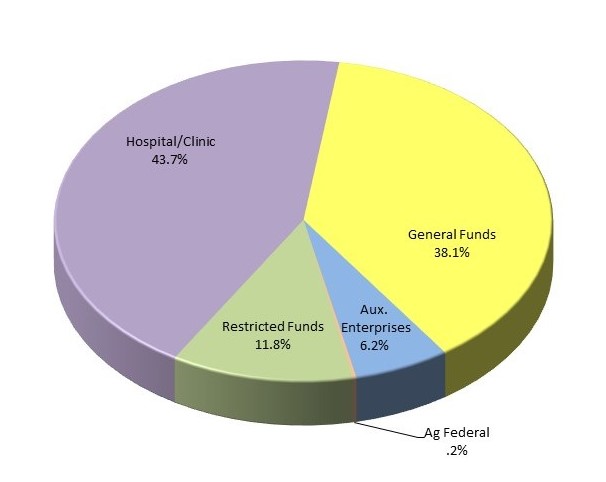
2019-20 Expenditure and 2020-21 Budget Data is available in detail at the links below.
General Funds
The general funds budget, representing approximately 40% of Penn State's total operating budget, covers the core of the University's teaching, research, and service efforts. General funds also encompass academic and administrative support and maintenance of the physical plant. Income to support the general funds budget comes from: tuition and fees paid by the student; state appropriations; and other income including facilities administration, investment income, and sales and services of departments.
Agricultural Federal Funds
Agricultural Federal funds represent federal appropriations authorized by the Smith-Lever Act, the McIntire-Stennis Act, and the Hatch Act. These funds are appropriated by the federal government to support agricultural research and cooperative extension programming within each state through the state's designated land-grant university.
Auxiliary Enterprise Funds
Auxiliary Enterprise funds are completely self-supporting activities with income derived from sales of services or products. No student tuition or state appropriations are used to support auxiliary enterprises. Examples include: The Nittany Lion Inn, Intercollegiate Athletics, and Housing and Food Services.
Restricted Funds
Restricted funds include grants and contracts from private sources, primarily for research. These funds are targeted for specific projects and can't be used for other purposes. Restricted funds also include philanthropic gifts to support student scholarships as well as other special needs of the University.
University Services Funds
University Services funds are self-supporting units which derive their income from charges for services provided to other departments within the University. University Services budgets are intra-university expenses and are excluded from fund totals to avoid double-counting of expenses.